The primary research goal of the Research Unit at the University of Naples Federico II (UNINA) is to explore the potential of Key Enabling Technologies (KETs) at the residential scale. Specifically, the study examines how advancements in digital technologies could reshape the design of housing spaces, focusing on a pilot for a climate-proof smart residence as a sample of emergent dwelling. The umbrella concept of emergent dwelling is introduced to capture various functional requirements reflecting new forms of housing, beyond decarbonization-focused KETs.
The initial research phase involved an extensive review to identify key concepts related to the topic of Convergent Innovation, a form of meta-innovation involving ecosystemic and behavioral transformation for sustainable prosperity centered on the paradigm of the universal right to health and accessible healthcare. This theoretical approach has been applied to understand the level of innovation in architectural design projects through a comparative analysis of case studies related to smart and emergent dwelling. From this analysis, a methodological framework has been developed to define the criteria of selection for a pilot case linking emerging needs (e.g., climate resilience, pandemic preparedness, circularity) with different spatial domains and socio-technical dimensions of housing.
Applying this methodology led to the identification of a “Multigenerational and Age-Friendly Lifetime Home” project to be tested in the former Civic Center Polyfunctional Marianella (Naples) as a pilot. The experimental approach followed an evidence-based methodological process, combining quantitative and qualitative analyses. This process yielded several outcomes: understanding of the urban settlement system and climate impacts through environmental indicators, analyzing the social system and mapping local stakeholders, defining climate-resilient strategies, and modeling microclimatic environmental parameters alongside socio-ecological benefits.
The analysis, conducted as part of a pilot project, applied the key enabling technologies as research focus along three main directions:
UNIVERSITÀ DEGLI STUDI DI NAPOLI
Mario Losasso, Erminia Attaianese, Marina Rigillo, Federica Dell'Acqua, Cristina Visconti, Sara Verde
Territorial scale
The former Centro Polifunzionale Marianella is located in the Piscinola district (Naples).
The district is an environmentally complex system, made by an articulated urban settlement, a relevant natural capital and an important infrastructural network for the connection with the city. The social structure is diversified and complex, representing a plurality of needs in the area.
Above all, the area has a significant and multi-level system of parks, from rural green areas to the natural system of Vallone di San Rocco to the Capodimonte and the Scampia Park.
The former Polifunzionale Marianella has a strategic and attractive position within the two districts, to its closeness to the new headquarters for the health professions of the School of Medicine and Surgery of the University of Naples Federico II, to the underground station and the Scampia Park.
Building Scale
The Polifunzionale building, designed in the 1980s by the architect Gerardo Mazziotti, has an articulated morphology with low thermal performances and outdoor spaces lacking in thermal comfort conditions.
The building is inspired by the Lecourbusian principles of the golden section, the modulor and the roof garden.
Today the green system is abandoned, not connected in its parts and climate-proof ineffective, and the building has several energy performance decays.
Methodology of research
The research methodology is a knowledge-based analytical-deductive approach and a deductive and comparative one in the experimental phase. The methodology, evidence-based and data-driven, allowed the development of a modelling, simulation protocol of the microclimate behaviour of the building-open space system aimed at the choice of climate-resilient solutions.
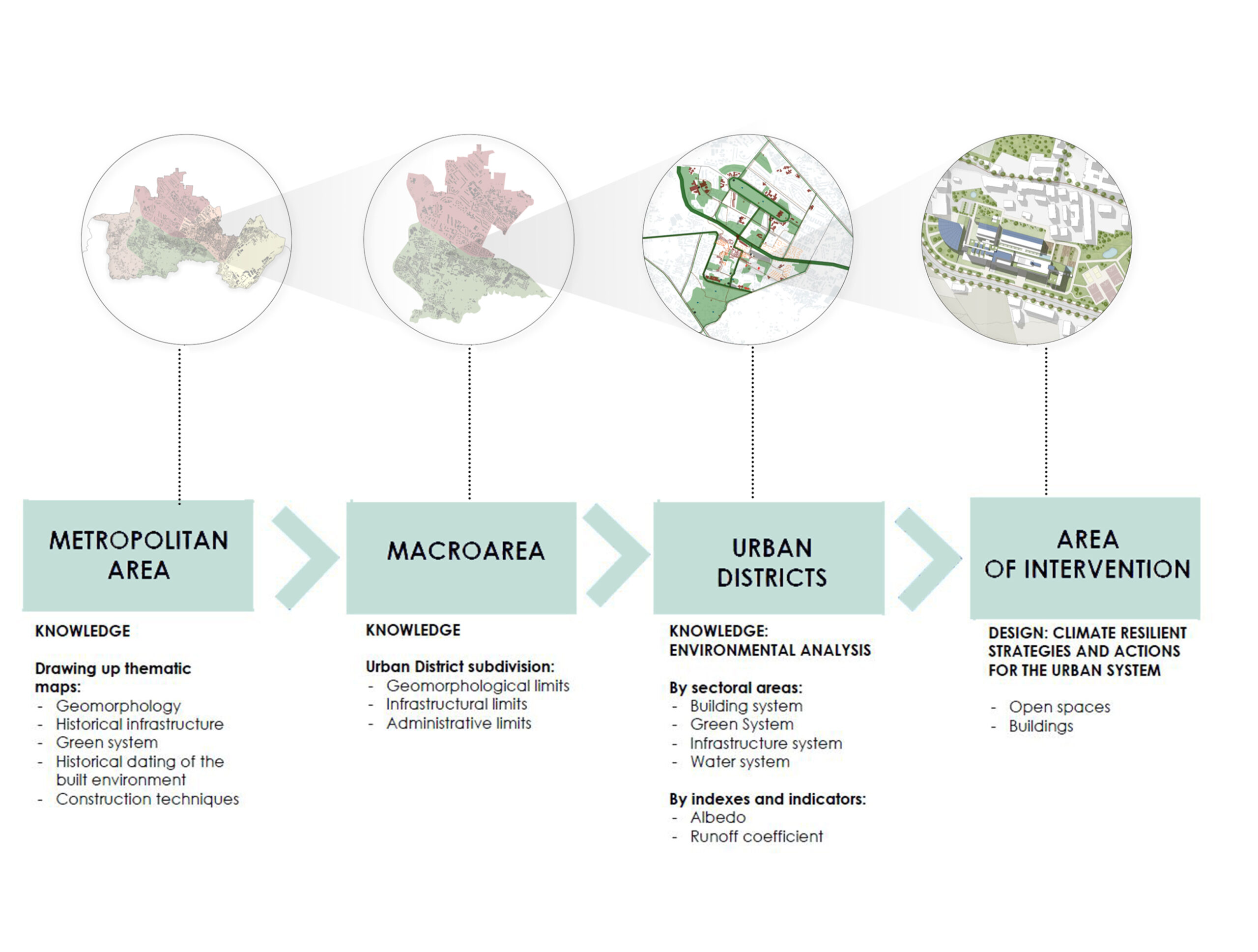
To analyse the Piscinola district as an environmental system, the knowledge-based approach was divided into the following phases
1- analysis of the environmental system based on the system of the built represented (buildings and open spaces) of the infrastructures and technological networks, of the green and ecosystem factors and of the water (hydrographic system and water management). This analysis returns the different levels of interaction between the natural and man-made environment.
2- construction of a queryable database for verifying the district’s environmental performance through environmental quality indices and indicators (albedo, runoff, permeability of urban surfaces) managed in a GIS environment;
3- elaboration of a Strategic Program proposal, based on the analyses, to achieve a climate-resilient urban structure in the district.
The approach to the experimentation was deductive to identify, based on knowledge, climate resilient design solutions for the building-open space system of the Multifunctional.
The comparative approach validated the design choices, verifying through KETS (ENIVI-met software, Dragonfly, Grasshopper) before and after the project the improvement of parameters for outdoor comfort and microclimate behavior.
Testing of climate resilient design solutions
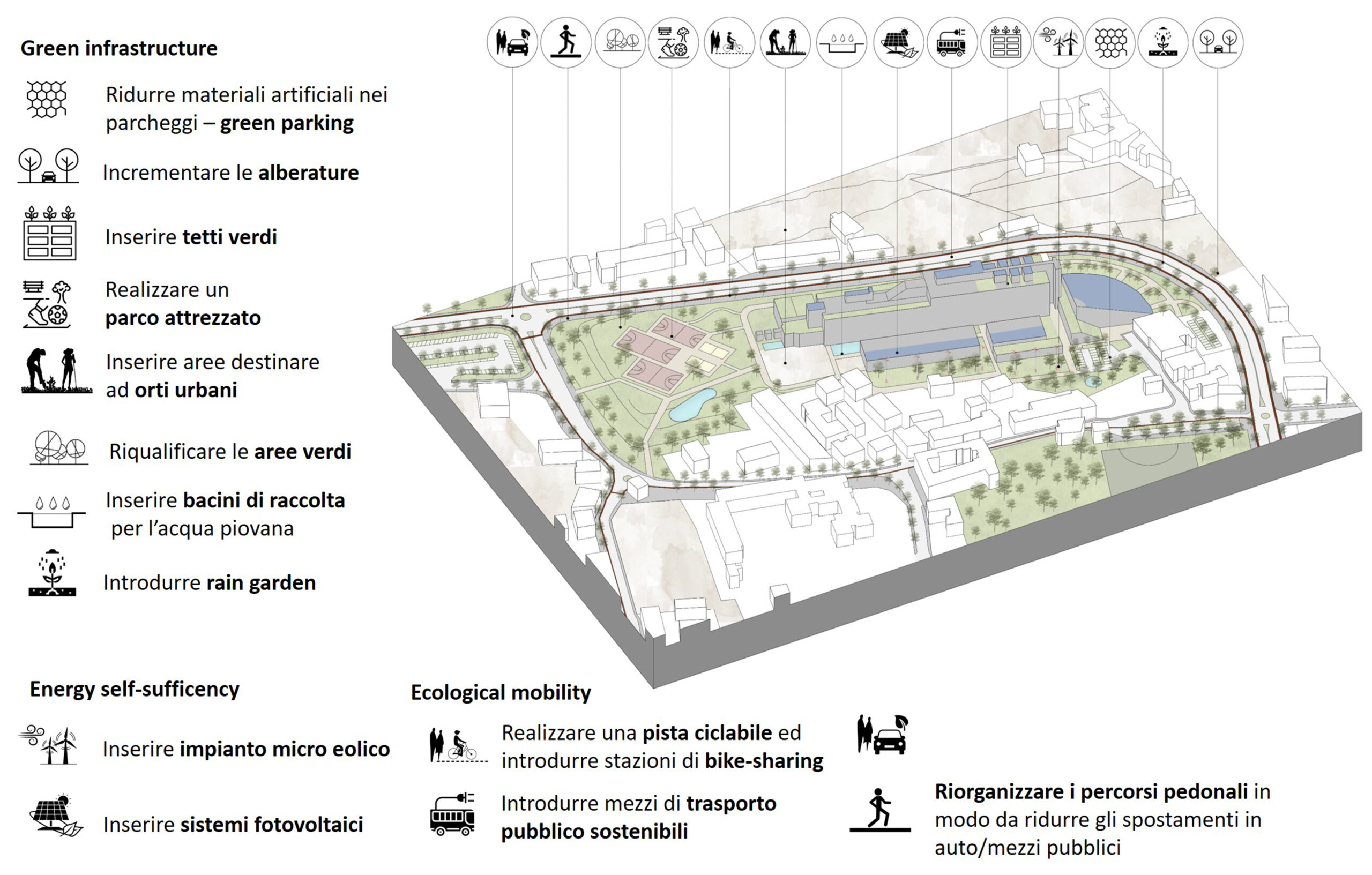
The climate resilient intervention categories are, for outdoor spaces
– greening, for reducing CO2 concentration, improving outdoor thermo-hygrometric comfort; evapotranspiration, reducing the impacts of heat waves
– de-paving, to reduce the level of waterproofing and contribute to the surface runoff of rainwater
– cool materials, characterised by high solar reflectance to reduce surface temperatures
on the building:
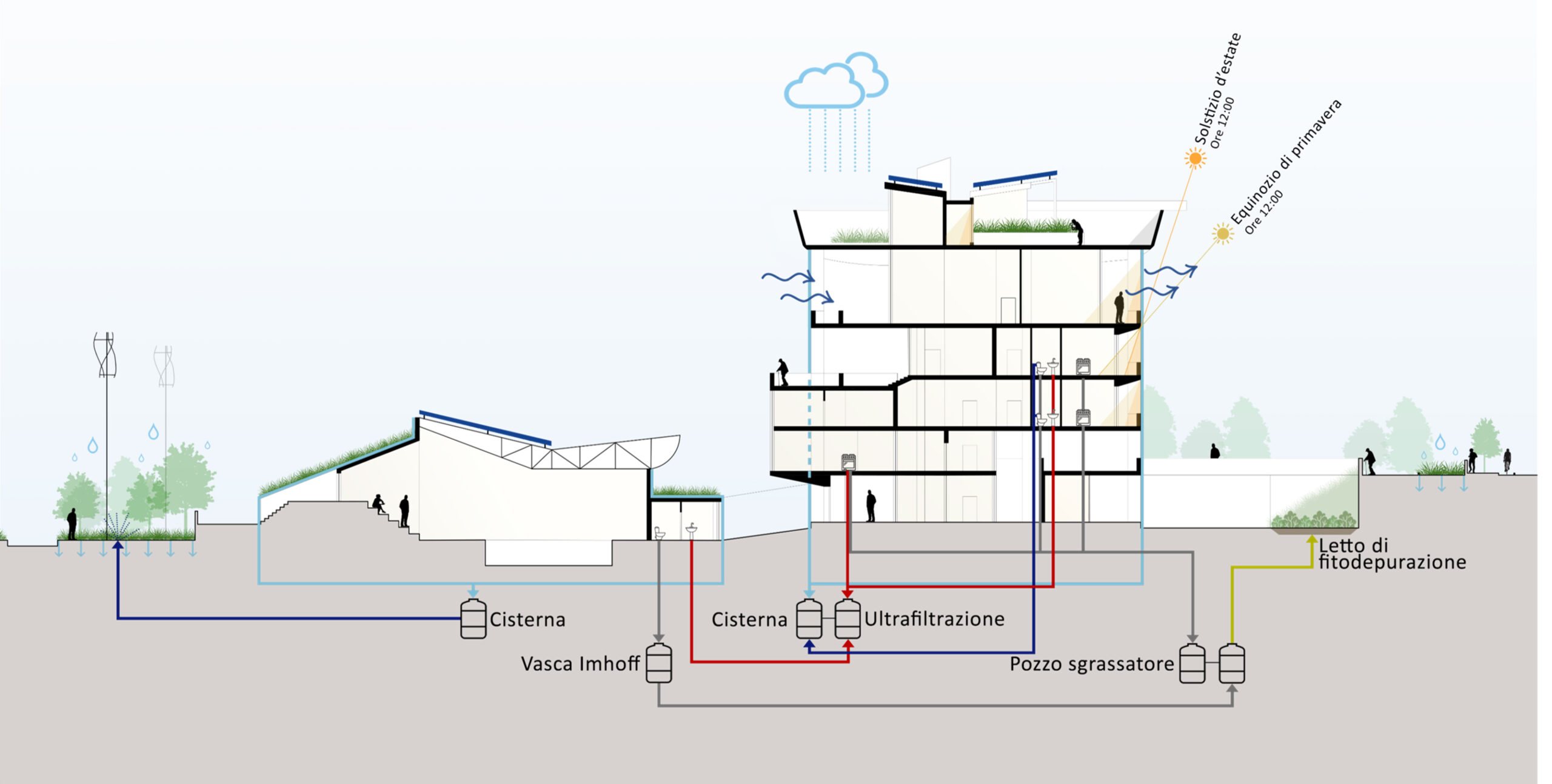
– extensive green roofs to limit heat loss and increase the roof’s ability to reflect solar radiation;
– replacement of window frames with high performance frames to reduce heat loss from the building;
– photovoltaic installations to reduce GHGs emissions
The testing of solutions is based on modelling and simulation of the building and open space by calculating the PMV – Predicted Mean Vote; Tmrt – Mean Radiant Temperature; PoT – Potential Air Temperature; TSur – Surface Temperature; CO2 concentration. The values demonstrate the effectiveness of the proposed design solutions to improve the adaptive capacity of the Polifunzionale to climate impacts caused by events such as heat waves.
Socio-spatial characteristics and Stakeholder mapping
In accordance with the methodological approach of the pilot project, a socio-spatial analysis and stakeholder analysis have been developed to contextualize the interventions, considering the socio-spatial features and potential of local ongoing initiatives and actors. The urban scale of the pilot project necessitated a comprehensive examination of various dimensions, including socio-demographic data and mapping of local stakeholders. The study identified key socio-demographic characteristics (age, education, employment rate, gender), highlighting a profile of vulnerability in the neighborhood. The stakeholder analysis comprised a three-step methodology:
The district is characterized by a strong presence of the third sector, which includes education, social integration, theater and arts, sustainable food, and environmental protection initiatives.
Digital Platforms for Community and Stakeholder Engagement
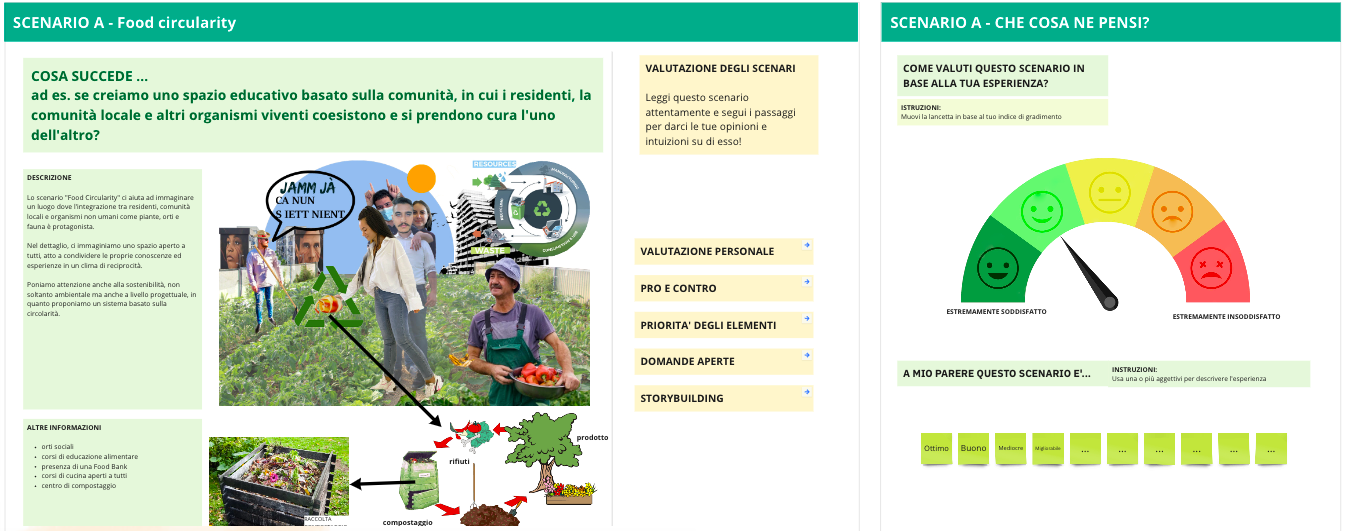
Collaborative exercises for the design of digital tools (apps and digital whiteboards) have been conducted with the participation of researchers and design students to develop interactive tools for stakeholder engagement aimed at participatory assessment of project scenarios and co-design of intervention strategies. This involved utilizing a methodology of need analysis, emotional assessment, story building, and stakeholders networking. The platform was developed using the “MIRO” tool, an innovative visual collaboration instrument effective for real-time sharing and collaboration on digital whiteboards.
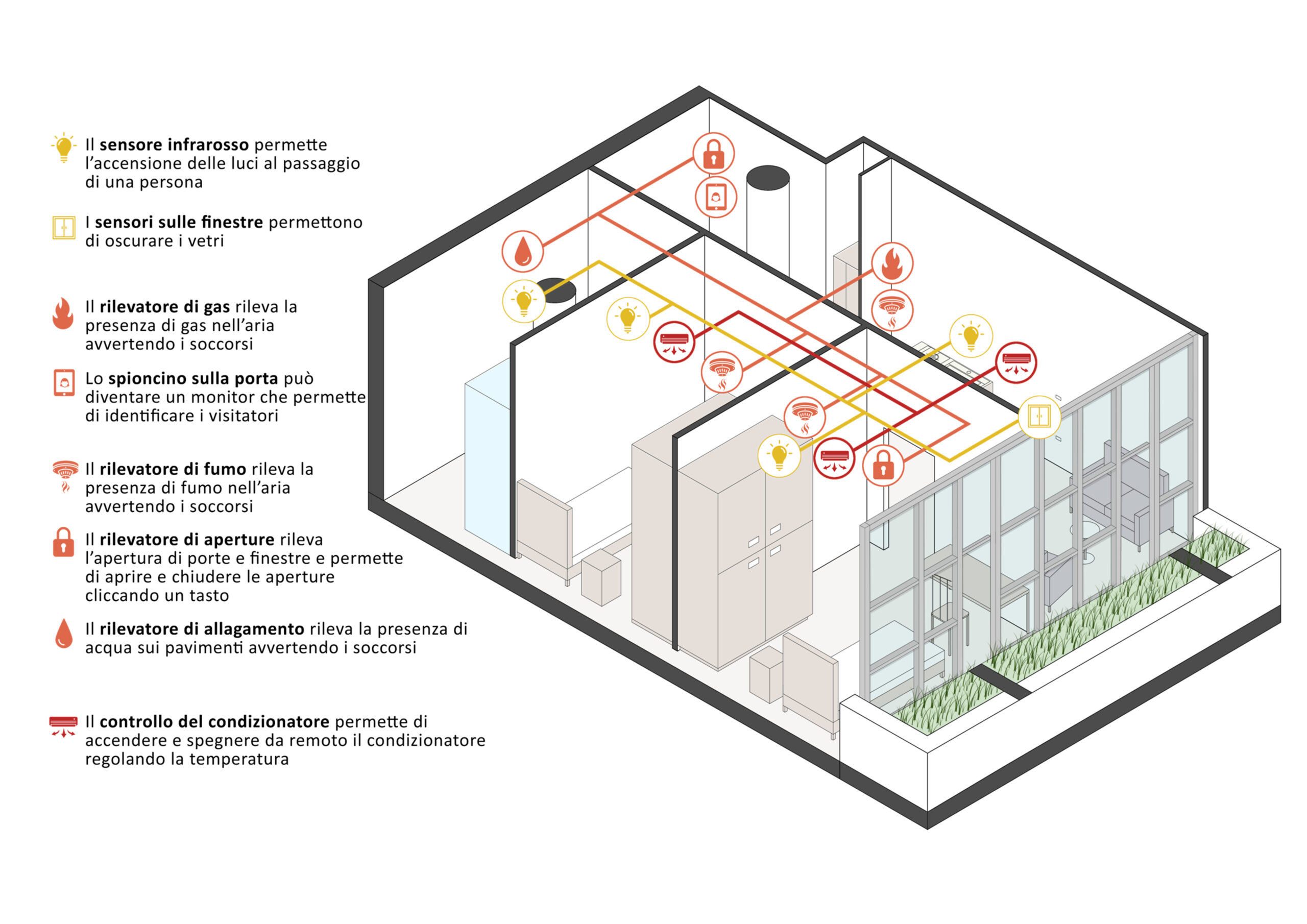
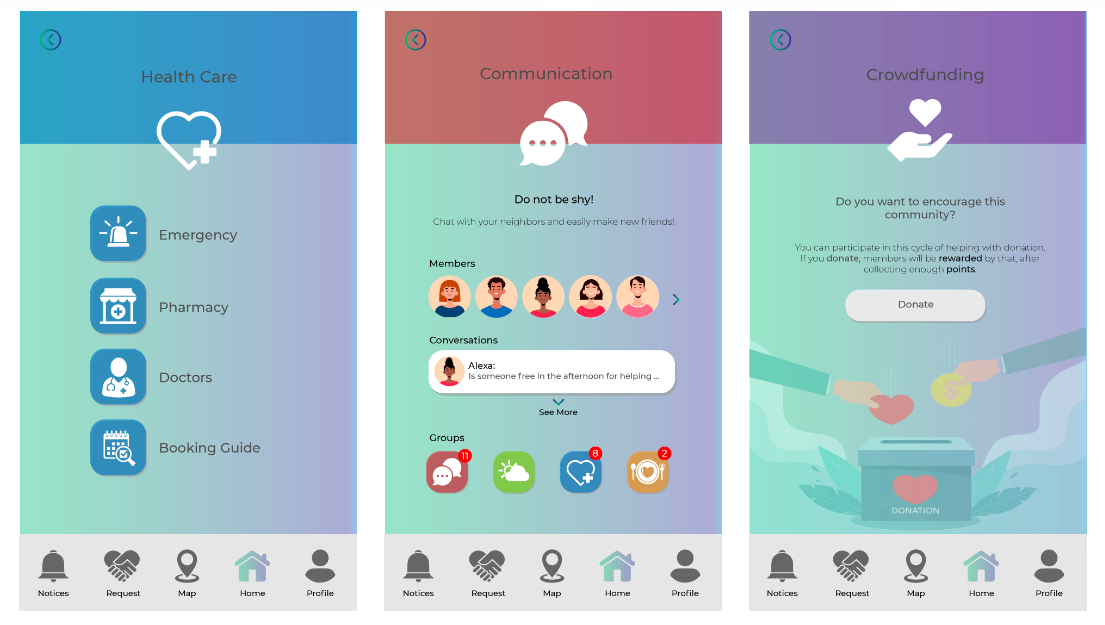
In the development of inclusive digital technologies for emerging forms of residential living for the pilot project, a digital application was designed for both the project’s end users and the broader local community. It is intended to provide information, create networking opportunities, and promote inclusion. The multifunctional application is dedicated to integrating and promoting sustainability in various crucial areas of daily life, including food, climate, communication, solidarity, and health, in line with the intervention guidelines of the pilot case dedicated to “connected care” and multigenerational housing.